Focus on Research & Community

Open Food Facts Days 2026

Fri 13th – Sat 14th November
Paris, France

Register here

Wissenschaftlich fundiert und Unterstützung der Wissenschaft

🔬 Open Science & Digital Commons • Since 2012

Wissenschaft ist eine der Grundpfeiler von Open Food Facts. Since 2012, we have turned peer-reviewed nutritional and environmental research into accessible public tools, while providing the world's scientific community with an open digital commons to advance public health.

600+
Google Scholar Papers
Open Food Facts verfügt über viele Möglichkeiten, um Daten im großen Stil mit Hilfe von Crowdsourcing zu erstellen.
138+
Curated Studies
Indexed in our research showcase
100%
Open Data (ODbL)
Free, transparent & verifiable
100+
Research Teams
Institutes, labs & universities
Core Foundations

Our Three Scientific Pillars

How Open Food Facts connects academic rigor, crowdsourced data, and open science.

🥗

1. Science-Based Scoring

We do not invent proprietary scores. We strictly implement official, peer-reviewed public health metrics: Nutri-Score (EREN / Inserm), NOVA food processing classification (Prof. Carlos Monteiro, USP), and Eco-Score / Green-Score (ADEME Agribalyse), making complex science understandable in grocery store aisles.

🤖

2. Technology at Scientific Scale

Our open-source platform combines citizen crowdsourcing with optical character recognition (OCR), neural vision networks, and natural language processing to extract, structure, and validate nutritional declarations, ingredient lists, and additives on millions of products.

🌐

3. Returned to the Global Commons

All collected product data and computed indicators are redistributed under the Open Database License (ODbL). Researchers worldwide enjoy barrier-free, permanent access to high-fidelity food data without paywalls, commercial restrictions, or vendor lock-in.

Transparenz beschleunigt die wissenschaftliche Forschung und die Zusammenarbeit zur Gewinnung neuer Erkenntnisse

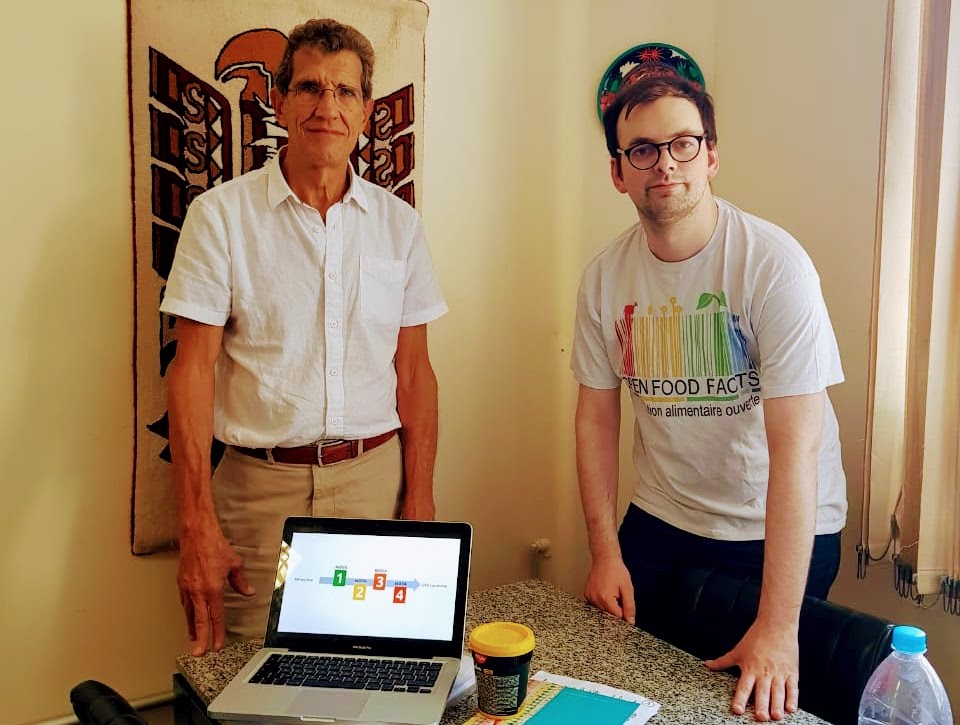
Zusammenarbeit mit dem mexikanischen Forschungsteam

Partnering with world-renowned epidemiological institutes, public health agencies, and academic labs.

Latin America Nutrition
Logo der französisch-mexikanischen Stiftung für Medizin

Das Team der Fundación Franco-Mexicana para la Medicina veranstaltete eine umfangreiche Scan Party in Mexiko, um eine Datenbank zur Unterstützung ihrer Forschung zu bilden und eine länderübergreifende Bewertung zu ermöglichen.

The Fundación Franco-Mexicana para la Medicina spearheaded nationwide Scan Parties across Mexico to map industrial reformulation, evaluate front-of-pack warning octagons, and enable international nutritional comparisons.

Citizen Science
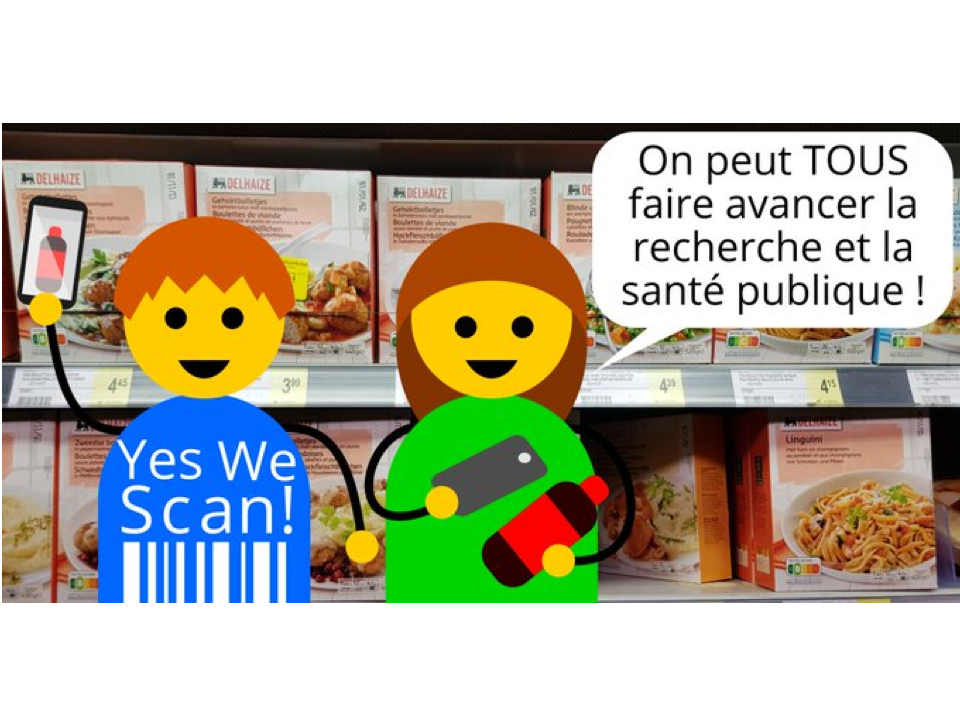
Crowdsourcing and Citizen Science tools

Crowdsourcing for Research at Scale

Open Food Facts equips research teams with self-service tools, specialized mobile scanning modes, and barcode campaign dashboards, allowing academic labs to build representative food brand samples rapidly at near-zero expense.

Google Scholar
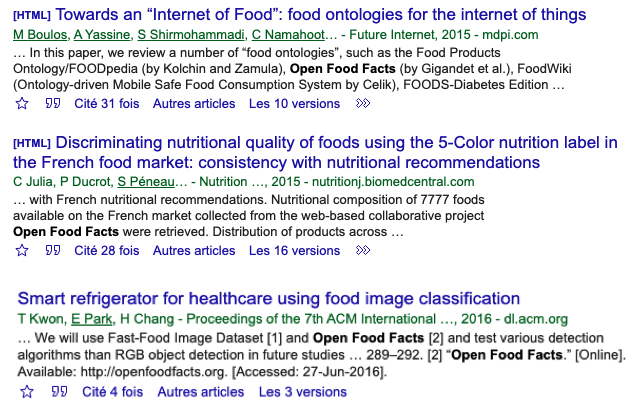
Artikel mit Zitaten zu Open Food Facts auf Google Scholar

Peer-Reviewed Publications

Open Food Facts data is actively cited and analyzed in hundreds of peer-reviewed journals, including The Lancet, BMJ, Nature Food, and Nutrients, spanning nutritional epidemiology, artificial intelligence, and environmental life cycle analysis.

„Angesichts der großen ernährungsbedingten Herausforderungen, mit denen wir heute weltweit konfrontiert sind, ist es von entscheidender Bedeutung, den Konsum einer gesundheitsfördernden Ernährung zu fördern. In diesem Zusammenhang ist eine digitale Datenbank mit Informationen über die verschiedenen gesundheitlichen Aspekte von Lebensmitteln (Nährstoffzusammensetzung, Verarbeitungsgrad, Zusatzstoffe usw.) ein wesentliches Instrument für die Forschung und die Maßnahmen im Bereich der öffentlichen Gesundheit.”
SH

Professor Serge Hercberg - Entwickler des Nutri-Score

Emeritus Professor of Nutrition, Université Sorbonne Paris Nord • Creator of the Nutri-Score

Transparency & Commons

How Open Data Accelerates Scientific Research

The Wikipedia of food: turning messy real-world packaging into structured research infrastructure.

📊

Standardized Food Taxonomies

Open Food Facts organizes multi-country packaging data with standardized taxonomies for food categories, ingredients, allergens, food additives (E-numbers), nutrient reference values, and recycling instructions across 150+ countries.

🧬

Interdisciplinary Exploration

Beyond clinical nutrition, our database powers breakthroughs in computer science (optical character recognition, multimodal vision-language models), behavioral economics (supermarket nudge studies), and food sustainability (greenhouse gas footprints).

🔄

Reproducibility & Open Science

Scientific credibility demands reproducibility. Because Open Food Facts archives historic snapshots and open calculation source code, researchers can replicate findings, benchmark algorithms, and publish open datasets without commercial secrecy.

Resources & Access

Researcher Toolkit & Data Access

Wenn Sie Open Food Facts im Rahmen eines wissenschaftlichen Projekts verwenden oder dies in Erwägung ziehen, teilen Sie uns dies bitte unter contact@openfoodfacts.org mit

📦 Database Snapshots

Download daily database dumps in JSONL, CSV, MongoDB, and Parquet formats for big-data and statistical analyses in Python, R, or Julia.

Access Data Dumps ➔

🔌 REST API & SDKs

Query live product data with our free REST API and official client libraries for Python (openfoodfacts-python), R, Dart, and JavaScript.

Read API Docs ➔

🔬 Curated Publications

Browse 138+ academic articles categorized by research themes: Nutrition, NOVA & UPF, Additives, AI & Vision, and Environment.

Browse Publications ➔

📖 Science Wiki & FAQ

Explore our community science guide with best practices for handling missing nutrients, deduplication, and geographic filtering.

Visit Science Wiki ➔
Academic Citation

Entdecken Sie wissenschaftliche Publikationen, die Open Food Facts zitieren

Ensure proper attribution under the Open Database License (ODbL) by referencing the database snapshot date.

APA Style (7th Edition)
Offene Lebensmittel-Fakten. (2025). Open Food Facts Database [Data set]. Abgerufen von https://world.openfoodfacts.org/data

BibTeX Format
@misc{openfoodfacts_database,
  author       = {{Open Food Facts}},
  title        = {Open Food Facts: A Free, Collaborative Global Food Database},
  year         = {2025},
  url          = {https://world.openfoodfacts.org/data},
  note         = {Open Database License (ODbL)}
}